Twice a day there is an opportunity for beautiful photos without having to introduce much for extra lighting. As the sun rises and as the sun sets there is a lighting situation known as “golden hour”. Light becomes warmer, and the shadow direction on a subject (particularly a person) becomes more flattering.
The reason sunrise and sunset have a warmer appearance is because there is more atmosphere at the horizon for the light from the sun to travel through. Blue and violet light waves (high frequency) are easily scattered; we see them well during the day when there is less atmosphere for the light to pass through (the answer to the age old question of why the sky is blue), but these light waves dissipate before they reach our eyes at sunrise or sunset, leaving only low frequency orange and red. Want to make these colours even more vibrant on your photos? It's possible to make the light appear even more gold by using a cloudy white balance on your camera.
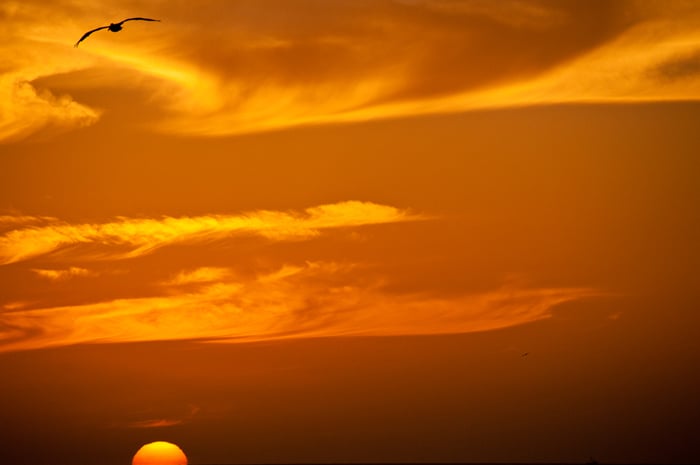
With golden hour there come several options for creativity. Depending how you set up your shot, you can either have your subject dark as a silhouette with the sun as a background, or have the sun as your main light source (key light). When shooting into the sun it is a good idea to use a neutral density filter in front of your lens, or use a higher f-stop. Digital camera sensors are easily overwhelmed by direct sunlight, causing unnatural digital bleed, or even damaging the sensor.
A little side note, it you're using an SLR camera to shoot into the sun, avoid looking through the viewfinder as much as possible; most SLRs have darkened viewfinders, but that won't protect your eyes properly from retinal damage. One more thing here; the sun doesn't even have to be up to get a great shot. Some of the best light occurs when sunlight bounces off of clouds, long after it has set behind the horizon.


The unfortunate reality is that the most beautiful natural light is only available for a short time every day. Everything between sunrise and sunset leaves much to be desired. If you're looking to improve your images, follow this one simple rule; avoid midday direct sunlight. If you have to take photos in the middle of the day, find open shade.
Midday sun casts unflattering shadows under a person's eyes, often making them look older or heavier; this is what you could call an unpardonable photographic sin. Major publications such as National Geographic have been known to reject images from their staff photographers without so much as a second glance if they see midday sun as the main light source. Midday sunlight rarely makes a photo that stands out amongst the myriad of images we see every day.
The beautiful light of golden hour is available to everyone. No special equipment is required to take advantage of it, though perhaps some dedication for early sunrise conditions may be needed. Try it out, and avoid harsh midday sunlight; you'll find your images look better with minimal effort
If there is something you'd like to see a tip on, or a topic of interest, feel free to comment below with your ideas.