These are two top 10 lists that Kelowna doesn't want to be on.
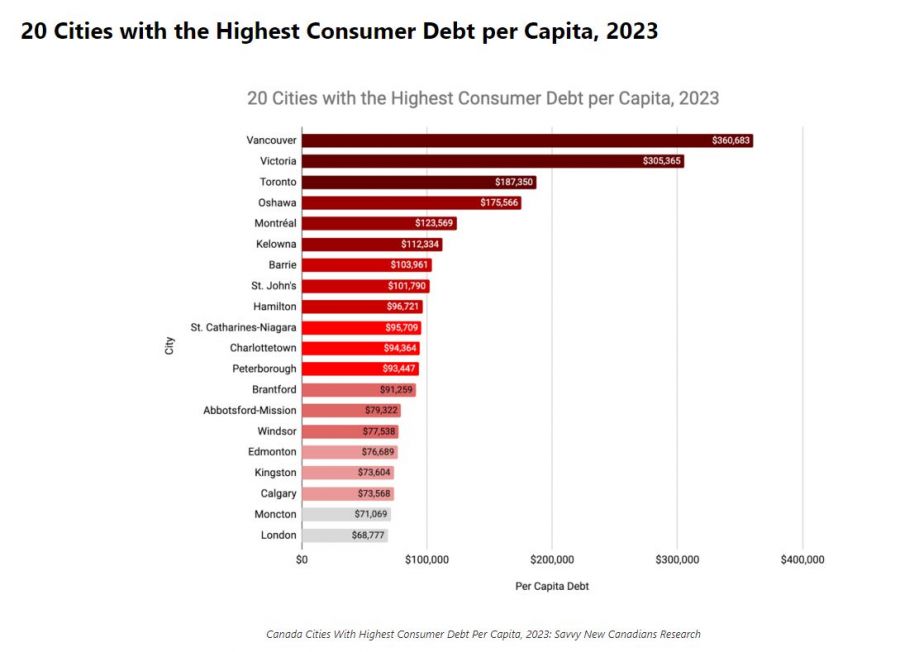
Kelowna owns No. 6 on the 2023 list of cities in Canada with the highest consumer debt per capita with a whopping $112,334 owed per person.
And on the list of cities with the largest credit card debt per capita Kelowna holds down No. 9 with $5,197 on cards per person.
The figures come from www.savvynewcanadians.com, one of the country's top personal finance platforms with resources to save for retirement, invest smartly and maximize credit card rewards.
It used data from Canada Mortgage and Housing Corporation and cross-referenced it with the latest population numbers from Statistic Canada's census metropolitan areas.
The survey numbers are per capita, which means the amount of debt is for every man, woman and child in Kelowna.
That means it includes kids that have no debt, retirees that don't owe anything on anything and the wealthy who have no debt.
So that leaves regular adults mired in credit card, line of credit, car loan, home equity line of credit and mortgage debt.
Considering kids, many retirees and the rich don't have debt, average adults could have way more than $112,334 consumer debt and $5,197 credit card debt listed.
Let's tackle consumer debt first.
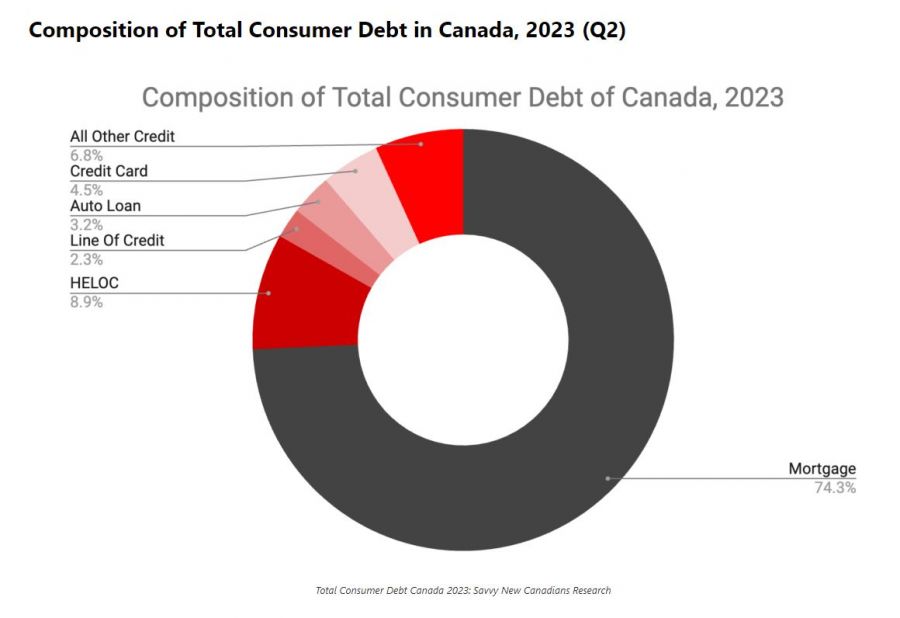
The $112,334 consumer debt per capita that's piled on in Kelowna is actually -- about 75% -- mortgage debt.
That means we're essentially house poor because much of our debt is what we still have to pay off, with interest, on our homes.
Again, here is where per capita is a number that makes gathering and reporting statistics tidy.
Much of our debt isn't tidy at all with many young and middle-aged adults drowning in debt because they've purchased a home recently at sky-high prices and could conceivably have $400,000 or $500,000 in debt per capita.
As you'll see on the accompanying 'debt wheel,' mortgage debt accounts for the vast majority of our total consumer debt with home equity line of credit taking up almost 9%, credit cards adding up to 4.5% and lines of credit, car loans and other forms of credit also in the single digits.
Since mortgage debt is the biggest contributor to consumer debt, it's no surprise that cities with the most astronomical house prices top the list of highest consumer debt in Canada.
For instance, the per capita consumer debt in Vancouver is a staggering $360,683, in Victoria a hefty $305,365 and Toronto a weighty $187,350.
Kelowna's house prices typically coming in at $992,000 for a single-family home, $757,000 for a townhouse and $496,000 for a condominium means almost everyone that takes on a mortgage is going to see their per capital consumer debt skyrocket.
You can see for yourself on the chart below how consumer debt piles up in 20 cities across the country.
Savvy New Canadians' figures are quite specific as it calculated Kelowna's per capita consumer debt of $112,334 from total consumer debt in the city in 2023 at $16.24 billion.
That's up $2.3 billion, or 14%, from the total consumer debt of $13.95 billion in 2019.
That's rapid growth and takes into account the post-pandemic surge in house prices and runaway inflation forcing people to turn to credit card and line of credit spending to keep up.
Nationally, Canadians are shouldering an astonishing $2.42 trillion in consumer debt, up 18% from the $1.99 trillion it was at in 2019.
Canadian household debt is the highest in the G7, the group of countries that make up the seven most advanced economies in the world (Canada, France, Germany, Italy, Japan, UK, US and European Union) with most of our debt tied to mortgages.
While the Savvy New Canadians report did not directly suggest solutions to our consumer debt burden, it repeatedly pointed to the high price of housing and mortgage debt as the problem.
Municipal and provincial governments as well as the federal government are working on strategies to make housing more affordable, but it's often viewed as too-little-too-late.